Success Stories
4
min read
Centralizing Last-Mile Delivery: The Faster Path to Better SLAs & Lower Costs

Allison Chen
Published on:
February 9, 2026
Updated on:

Published on:
February 9, 2026
Updated on:
Final-mile delivery logistics is rarely the problem you plan for—but it’s often the one that creates the biggest operational headaches.
For many national enterprises, last-mile execution becomes increasingly complex as order volumes grow, delivery regions expand, and fleets become a blend of owned vehicles, contracted carriers, and regional partners. When orders flow in from multiple systems and delivery operations rely on manual routing and handoffs, inefficiencies compound quickly.
That was exactly the challenge facing one national enterprise—until they centralized their last-mile operations with Dispatch.
📄 Want the full use case? Download the PDF here.
This enterprise’s last-mile operation had become a constant balancing act. Orders came from multiple systems and required coordination across different types of delivery capacity, including owned fleets and partner networks. But with routing, matching, and handoffs handled manually, the margin for error was high.
Three core issues created consistent operational drag:
Manual driver matching left vehicles underutilized, with idle time averaging 22%.
Without strong tracking and exception management, performance blind spots made it difficult to address issues before they impacted customers. The result: missed SLAs on 1 in 7 orders.
Every new market required new processes, and onboarding delivery partners took 3–4 weeks, slowing scaling efforts.
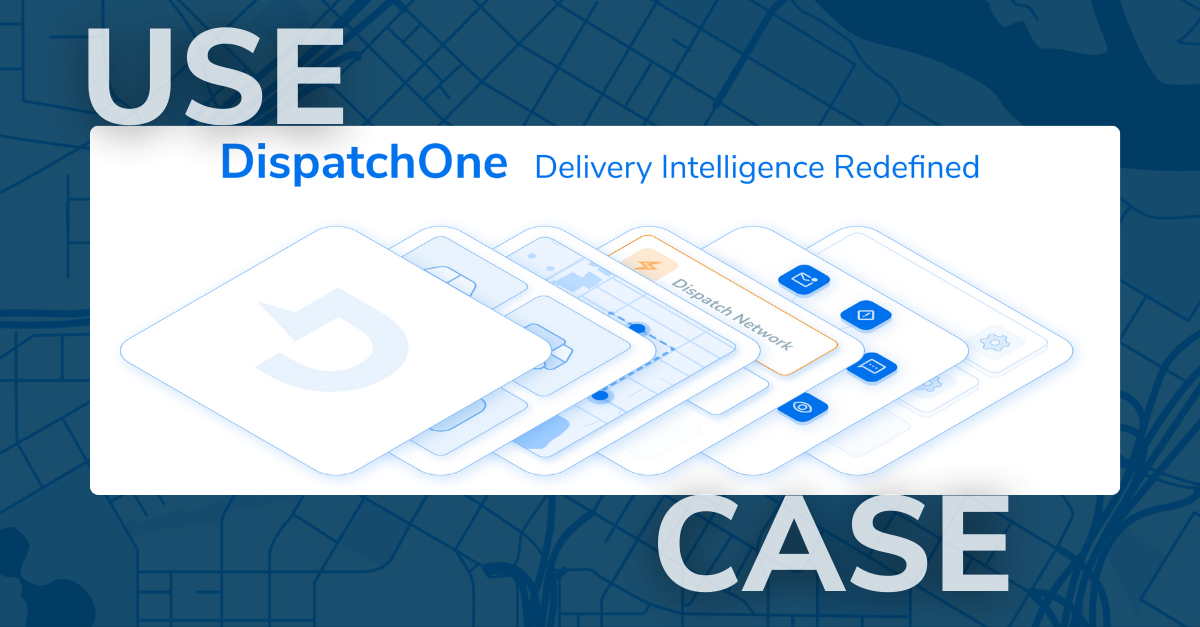
To regain control and improve delivery performance, the company adopted Dispatch as a centralized last-mile control center—connecting all jobs, drivers, and partners into one platform.
Rather than patching together point solutions, they implemented high-impact capabilities designed to improve:
Here’s what they deployed:
By consolidating delivery requests and automating job creation, the company reduced order intake errors by 28%.
What this enabled: fewer manual steps, fewer errors, and faster dispatching across all delivery channels.
Dispatch automatically assigned orders to best-fit drivers and routes, improving delivery density by 17% and reducing cost-per-delivery by 12%.
What this enabled: more efficient routes, better fleet utilization, and lower cost to serve—without sacrificing service levels.
Managing all fleets through a single workflow helped improve partner on-time performance from 82% to 93%.
What this enabled: consistent execution across mixed delivery networks, even as volume and complexity increased.
With accurate ETAs and proactive notifications, the enterprise reduced “Where’s my order?” calls by 43%.
What this enabled: fewer inbound support calls, fewer escalations, and better customer confidence in delivery outcomes.
Dispatch dashboards surfaced bottlenecks and operational trends, reducing late deliveries by 21% in the first quarter.
What this enabled: teams could shift from reactive firefighting to proactive optimization.
After centralizing last-mile operations with Dispatch, the company saw measurable improvements across cost, speed, and service performance:
For enterprises, last-mile delivery isn’t just an operational function—it’s a customer experience driver and a profitability lever.
When last-mile operations run across disconnected systems, manual processes, and fragmented partner workflows, performance becomes harder to manage at scale. But when everything is centralized—orders, fleets, routing, tracking, and insights—teams gain the ability to:
Dispatch makes that possible by serving as the system of execution and visibility for the final mile.
If you’re managing a mix of fleets and partners, expanding into new markets, or looking to improve SLA adherence while reducing delivery cost, DispatchOne can help.
📄 Download the full DispatchOne Use Case, or request a demo to see how a centralized last-mile control center can work for your operation.


.webp)
