Articles
6
min read
Delivery Reliability Isn't an Accident. It's a Network Strategy.

The Dispatch Team
Published on:
November 12, 2026
Updated on:

Published on:
November 12, 2026
Updated on:
A delivery can show "completed" and still fail the customer. If the trusses arrive at 1:00 PM and the framing crew was ready at 7:00 AM, the contractor paid a crew to stand around, and the branch that sold him the trusses is the one he remembers.
For building products and industrial suppliers, delivery reliability lives in the gap between "delivered" and "delivered when the job needed it." That gap is where accounts are won and lost, and it’s getting more expensive.
In October 2026, builders reporting labor shortages averaged 47% across the nine trades the National Association of Home Builders tracks, up from 42% in April 2025 (NAHB, Oct. 2026). When crews are that hard to staff, an hour spent waiting on material is an hour nobody gets back.
Most suppliers answer the problem by adding capacity: another courier, another app, another pool of drivers to call when the internal fleet is full. That fixes availability. It does not fix delivery reliability, because reliable delivery is a network strategy, not a driver count.
Reliability in this business is harder than an on-time percentage suggests. Order sizes swing from a box of fasteners to a pallet of drywall in the same afternoon. Materials are heavy, long, or easy to damage. Every branch has its own dock hours, its own counter staff, and its own contractors who expect the driver to know which gate is open.
So reliability means four things, not one:
On-time performance measures the first. The other three are where most delivery setups break down.
A large pool of drivers answers one question: can someone take this order right now? It does not answer the questions that decide whether the delivery succeeds.
The driver who accepts the order may show up in a hatchback for a load of 16-foot trim. He may never have delivered to an active jobsite, or know that a pallet of insulation needs a weather-tight vehicle. Availability gets a driver assigned. It does not get the right truck, or the right experience, assigned.
Many distributors run a patchwork: internal trucks, a regional courier in one market, an app in another, and a hotshot service someone found for emergencies. Each has its own rules for photos, wait time, and what happens when nobody is on site. Ten branches and five providers produce five definitions of "delivered." A regional VP cannot hold branches to one standard when every provider reports differently, if they report at all.
In a marketplace model, the app matches the order and steps back. The driver answers to the app, the app answers to its terms of service, and the branch manager is the one on the phone with an angry contractor. When a delivery fails at a jobsite at 7:15 AM, the distributor needs one answer: who fixes this, and how fast? Another vendor to call is not an answer.
Every delivery operation has exceptions: a locked gate, a wrong address, a damaged bundle, a superintendent who isn't on site. A reliable network is defined by what happens next. The driver records a reason, takes a photo, attempts contact, and a person decides on re-delivery. In a fragmented setup, that sequence depends on which provider happened to take the order.
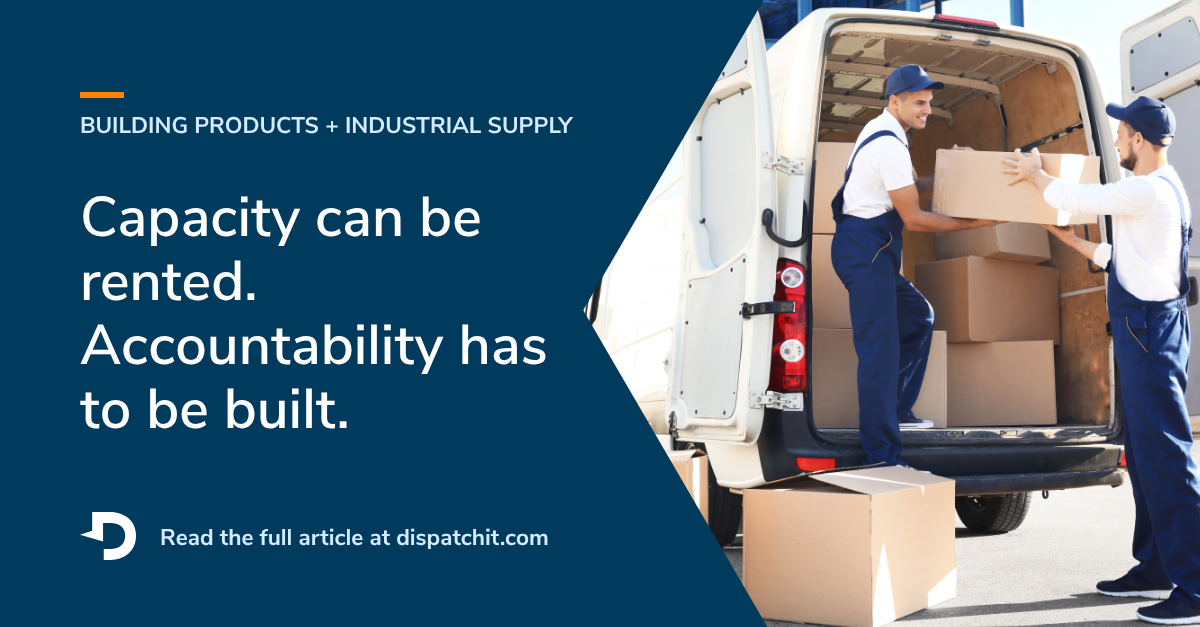
Key takeaway: a large pool of drivers isn't the same as a reliable delivery network. Capacity can be rented. Accountability has to be built.
If driver count is not the test, what is? Five things separate a coordinated delivery network from a list of available drivers.
Most technology players have software. Most logistics players have drivers. Very few have built both together. Dispatch built both.
DispatchOne runs routing, live tracking, proof of delivery, and exception handling for a supplier's own trucks and for Dispatch's network of 30,000+ professional drivers across 80+ markets.
Every Dispatch driver completes a verified background check and training. And because Dispatch manages the network, it holds drivers to its standards instead of hoping an app will.
The result is one accountable owner for the delivery, from assignment to proof, with the same standard at the first branch and the nineteenth.
For a distributor, reliable delivery is not a logistics metric. It shows up in the customer relationship.
Alside, an exterior building products supplier, uses Dispatch across 19 branch locations to flex between its own trucks and Dispatch's network. "Over the past four months, Dispatch has saved us nearly 240 hours on the road, allowing us to better serve our customers more efficiently," said Bryan Riddick, Operations Lead (read the Alside case study).
At United Rentals, Dispatch supports 52 locations nationwide and maintains a 99% on-time delivery record. One branch even has a preferred driver: a known professional who knows the yard and the customers, which is what accountability looks like at the branch level (read the United Rentals case study).
The future of industrial distribution won't be defined by who can find a driver fastest. It will be defined by who can deliver consistently, at scale, with the accountability customers expect.
Before you add another provider, ask four questions of every delivery partner you use today:
If the answers depend on which app took the order, you have capacity, not a network. Contractors don't remember the deliveries that went right. They remember the morning the crew stood around waiting, and which supplier caused it.
See how Dispatch supports building products distributors and industrial suppliers, or talk to a delivery expert.


